Authors: L. Lee Grismer, Lelani del Pinto, Evan S. H. Quah, Shahrul Anuar, Michael Cota, Jimmy A. McGuire, Djoko T. Iskandar, Perry L. Wood Jr & Jesse L. Grismer
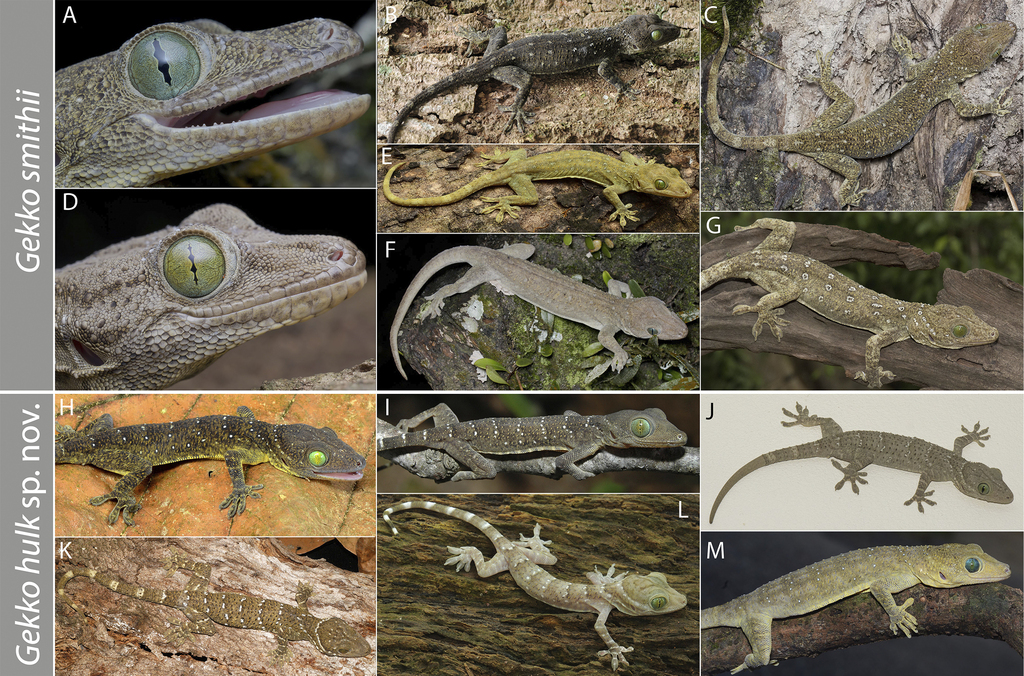
La ricerca del Dott. Grismer e colleghi non solo classifica una nuova specie (Gekko hulk), ma fa chiarezza in un gruppo di gechi dagli occhi verdi, fino ad oggi classificati come Gekko smithii. Animali che hanno sempre mosso perplessità tra ricercatori e appassionati, infatti, le varie popolazioni mostravano differenze fenotipiche piuttosto marcate, non solo in termini di livrea, ma anche di dimensioni. Per chiarire la situazione sono state necessarie analisi molecolari, che hanno finalmente reso possibile un quadro più distinto delle divergenze filogeniche presenti in questo gruppo di gechi.
Lo studio evidenza come Gekko smithii sia un complex di 4 lignaggi, probabilmente il risultato dell'isolamento bio-geofrafico (mari, monti, ecc...).
Gekko albofasciolatus (Günther 1867), specie considerata sinonimo di G. smithii, ma considerata valida da Bauer e colleghi già nel 2008 e ora confermata Grismer (et al. 2022). Specie presente principalmente nel Kalimantan, a Sud del Borneo nella parte indonesiana.
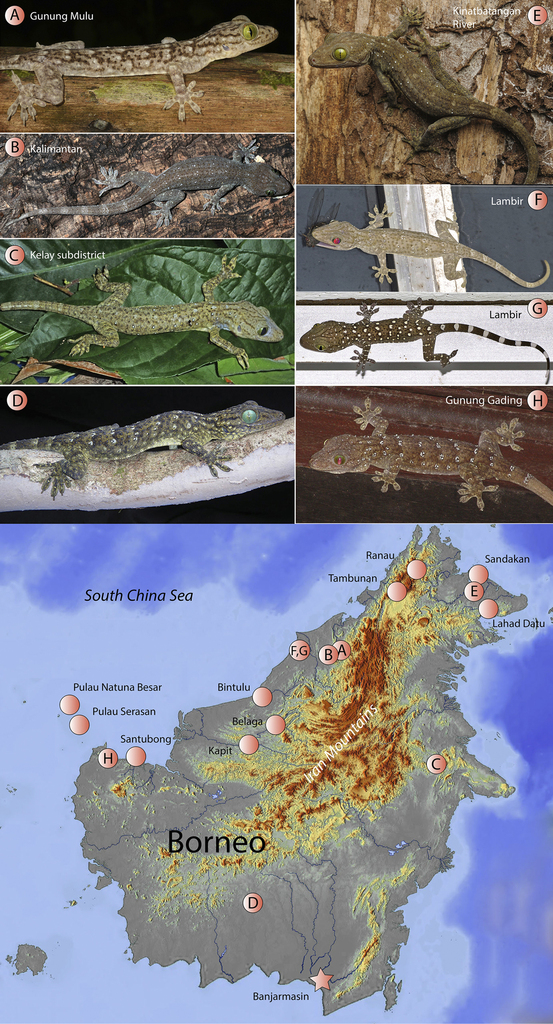
Gekko albomaculatus (Giebel 1861), considerato come G. smithii fino al lavoro di Grismer e colleghi (2022). Specie principalmente distribuita in Sumatra.

Gekko hulk (Grismer et al. 2022), nuova specie scoperta e descritta da Grismer e colleghi (2022), distribuita principalmente a Sud Est, della Tailandia.
Il nome della specie "hukl" deriva proprio dal fumetto Marvel, "l'Incredibile Hulk". I ricercatori hanno scelto questo nome perché a quanto pare il grosso e verde geco, ha anche un temperamento irascibile e aggressivo, esattamente come il supereroe.
Gekko smithii (Gray 1842), principalmente distribuito nella Tailandia e a Nord-Est della penisola malese.
Abstract
An integrative taxonomic analysis of Sundaic populations of Gekko smithii from the Thai-Malaya Peninsula, Sumatra, and Borneo recovered four deeply divergent mitochondrial lineages that are separated by major geographic barriers (mountains and seaways). Furthermore, they bear a number of concordant statistically significant differences in meristic and morphometric features, morphospatial separation in multivariate space, and discrete differences in color pattern. Gekko smithii sensu stricto is restricted to southern Thailand south of the Isthmus of Kra and Peninsular Malaysia west of the Banjaran (mountain range) Titiwangsa, being that the type locality is on Penang Island, Penang. Gekko hulk sp. nov. is a new species from extreme southern Thailand and Peninsular Malaysia east of the Banjaran Titiwangsa and five east coast islands—the type locality being Pulau (island) Tioman, Pahang. Gekko cf. albofasciolatus is tentatively used to include Bornean populations west of the Iran Mountains in Sabah and Sarawak which, in the absence of molecular data, cannot unequivocally be separated morphologically from G. albofasciolatus from the type locality at Banjarmasin, Kalimantan, Indonesia east of the Iran Mountains. In the absence of molecular data, G. albomaculatus is resurrected to include mainland Sumatran, Nias Island, and Banyak Islands populations which, based on their morphology, cannot be separated from descriptions of G. albomaculatus from the type locality of Bangka Island, 15 km off the southeast coast of mainland Sumatra. Further integrative analyses of all Sumatran and Bornean populations are currently underway as well as the enigmatic Wallacean populations from Sulawesi. Data are presented that strongly suggest all references to G. smithii from Java stem from a 151 year-old misidentification of a specimen of G. gecko of unknown provenance. Additionally, there are no vouchered records of G. smithii from Myanmar. The phylogeographic patterns of Sundaic populations of the G. smithii complex are concordant with those of a plethora of other Sundaic lineages.
Per saperne di più clicca qui.
Oppure scarica l'articolo originale in PDF.